The short answer is yes — and not just for the odd warm weekend. A well-specified aluminium pergola with a motorised louvered roof is built to handle every season the UK throws at it. Rain, wind, summer heat, and even light snow. The key is choosing a system designed with year-round use in mind, and pairing it with the right optional extras for your climate and lifestyle.
How Does a Louvered Pergola Handle Rain?
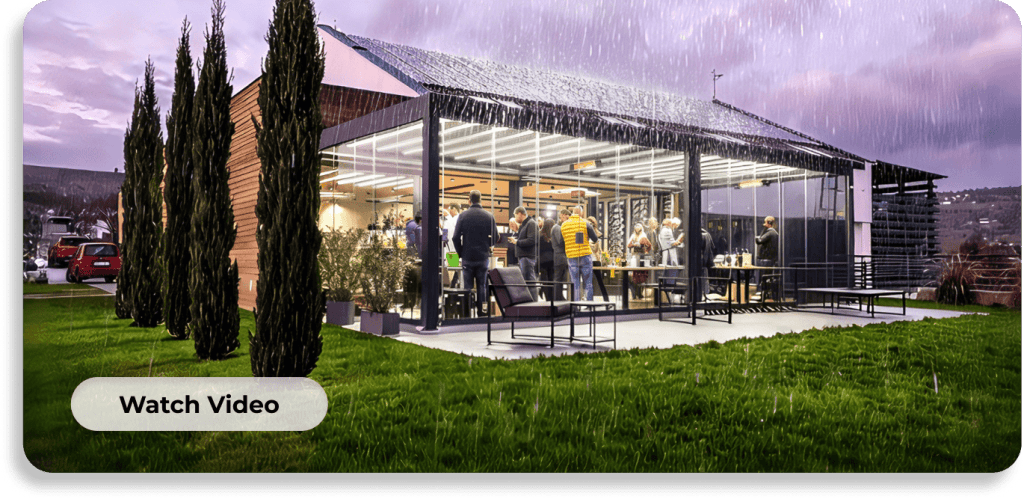
One of the most common concerns about pergolas in the UK is rain — and it is a fair one. But a quality motorised louvered roof is engineered specifically to handle wet weather.
- Interlocking louvre blades: When closed, the aluminium blades interlock and form a continuous, watertight roof. Rainwater does not pool — it runs off and is directed through internal drainage channels built into the structural posts, safely away from the space below.
- Integrated guttering: Drainage channels are concealed within the posts and beams, so you get a clean finish with no visible pipework or external guttering.
- Automatic rain sensor: Most systems can be fitted with a rain sensor that closes the louvres automatically when rain is detected — so you are protected even if you are not paying attention or you are away from home.
The result is a genuinely weatherproof outdoor room, not just a sun shade with ambitions.
Can a Pergola Withstand Strong Winds?
UK weather is not just about rain. Autumn and winter bring gusts that would make a lesser structure creak. A properly engineered aluminium pergola is designed to cope.
- Engineered aluminium frame: Structural-grade aluminium is rigid, lightweight, and will not warp, rot, or corrode. The frame is designed to handle wind loading appropriate for UK conditions.
- Solid foundations: The posts are fixed into the ground or onto a solid base, giving the whole structure the stability it needs in exposed locations.
- Wind sensor: Just as rain sensors close the louvres in wet weather, a wind sensor can automatically adjust or close the blades when wind speed reaches a set threshold — protecting both the mechanism and anyone using the space.
If your garden is particularly exposed, adding side screens or zip blinds will break the wind further and make the space much more comfortable in blustery conditions.
What About Snow and Cold Temperatures?
Snow is less common across much of the UK, but worth considering — especially if you are in Scotland, the Pennines, or anywhere that sees a proper winter.
- Load-bearing frames: A well-engineered pergola frame is rated to carry a meaningful snow load. The structure will not buckle under a light to moderate snowfall.
- Drainage channels clear snow melt: As snow melts, the integrated drainage system channels water away through the posts, preventing pooling or ice build-up on the roof surface.
- Cold temperatures are not a structural problem: Aluminium performs well in low temperatures and will not become brittle or distort in the cold. The motor mechanism is also rated for year-round use.
In genuinely heavy snowfall, closing the louvres fully helps distribute the load evenly across the roof — so common sense maintenance applies, but the structure is built for it.
A Season-by-Season Guide to Using Your Pergola
Here is how a well-equipped pergola works across all four seasons in the UK.
Spring
Spring in the UK is unpredictable — one moment sunny, the next a sharp April shower. With a louvered roof, you can open the blades fully on bright days to enjoy the fresh air and early warmth, then close them in seconds when the clouds roll in. Spring evenings can still be chilly, so if you have integrated heating it is easy to extend those afternoons outdoors well past sunset. The space becomes a genuinely useful room again after winter, rather than something you open up once the temperature hits 20°C.
Summer
In summer, the pergola earns its keep as a shade provider. Adjusting the louvre angle lets you control exactly how much sun comes in — full open for maximum light and airflow, or tilted to cut out the midday glare without blocking the breeze. On hot days this is significantly more comfortable than sitting in direct sun, and far more pleasant than retreating indoors. Side blinds or zip screens can be deployed to keep the space private or sheltered without closing it off entirely.
Autumn
Autumn is where the year-round capability really starts to shine. As the temperature drops and the rain becomes more frequent, close the roof and pull across the side screens to create a sheltered outdoor room. LED lighting built into the frame means the space is still usable in the earlier evenings, and an integrated infrared heater keeps the temperature comfortable even as outdoor temperatures fall. Autumn evenings with a closed pergola, good lighting, and a heat source can be genuinely lovely — far more atmospheric than sitting inside.
Winter
With sliding glass doors or fixed glazed sides added, a pergola can become a fully enclosed garden room in winter — still connected to the outdoors visually, but sheltered from wind and rain. Combined with infrared heating, the space remains usable even on cold days. It will not be as warm as being indoors, but for those who want to sit outside on Christmas morning or use the space year-round for entertaining, it delivers something genuinely useful. Many customers tell us their pergola becomes their favourite room in the house — and they use it every month of the year.
What Optional Extras Make a Pergola Suitable for Year-Round Use?
A standard motorised pergola is already a significant step up from a fixed canopy, but the right additions transform it into a true all-seasons space.
- Vertical blinds and zip screens: Fabric side panels that can be lowered fully or partially to block wind, rain, and direct sun. Zip screens in particular seal tightly to the frame and eliminate draughts.
- Sliding glass doors: For maximum enclosure, fully glazed sliding panels on one or more sides turn the pergola into a garden room. Glass sides maintain the open feel while providing full weather protection.
- Integrated infrared heating: Infrared heaters built into the frame heat people and surfaces rather than the air, so they work effectively even in open or semi-open conditions. They make a significant difference from September through to April.
- LED lighting: Integrated LED strips or spotlights built into the frame keep the space usable after dark. Good lighting completely changes the atmosphere of an outdoor space in the evenings.
- Rain and wind sensors: Automate the roof response to the weather, so the pergola looks after itself even when you are not paying attention.
Many customers start with the core structure and add extras over time — the systems are designed to be upgraded as your needs evolve.
Is a Pergola Warm Enough to Use in Winter?
This depends on how you specify it. A basic open-sided pergola in January will be cold — there is no getting around that. But a pergola with closed zip screens or glass sides, integrated infrared heating, and good lighting is genuinely comfortable in winter conditions. Infrared heaters in particular are effective at warming the space quickly, even when temperatures outside drop to near freezing.
It is not the same as sitting in a centrally heated living room — and most people would not want it to be. The appeal is maintaining that connection to the outdoors, with just enough shelter and warmth to make it comfortable. For many homeowners, that balance is exactly what they are looking for.
If full year-round warmth is your priority, consider combining your pergola with an infrared heating system and specifying glazed sides from the outset. The combination is far more effective than adding a heater to an otherwise open structure.
The Bottom Line
A motorised louvered pergola is not just a fair-weather feature. With the right specification — interlocking weatherproof louvres, integrated drainage, wind and rain sensors, side screens, glazing, and heating — it becomes a usable outdoor space across all four UK seasons. Whether you are enjoying a spring morning with the louvres fully open, hosting a summer dinner in filtered shade, or sitting out on a cold November evening with the heating on and the sides down, a well-designed pergola delivers genuine year-round value.
The key is not buying the cheapest structure you can find — it is investing in a system that is engineered for the conditions. That is what we supply at Direct Trade Windows.
Explore Our Aluminium Pergolas
If you are considering a pergola for your home or commercial project, take a look at our full aluminium pergola range — or get in touch for a quote tailored to your space and requirements.