A bioclimatic pergola is one of the most sophisticated outdoor structures available today — and one of the most misunderstood. The name sounds scientific, but the concept is straightforward: it is a pergola that adapts to the climate around it. Rather than offering a fixed level of shade or weather protection, a bioclimatic pergola responds dynamically to sun, rain, wind, and temperature through a system of adjustable aluminium louvre blades and intelligent automation.
At Direct Trade Windows, we supply and install premium bioclimatic pergola systems across the UK. This guide explains exactly how they work — from the mechanical engineering of the louvre system through to smart home integration — so you can make a fully informed decision.
What Does Bioclimatic Actually Mean?
The term bioclimatic comes from the disciplines of architecture and environmental design. A bioclimatic structure is one that interacts with the natural climate to optimise the comfort of occupants — rather than simply blocking out the elements or ignoring them entirely.
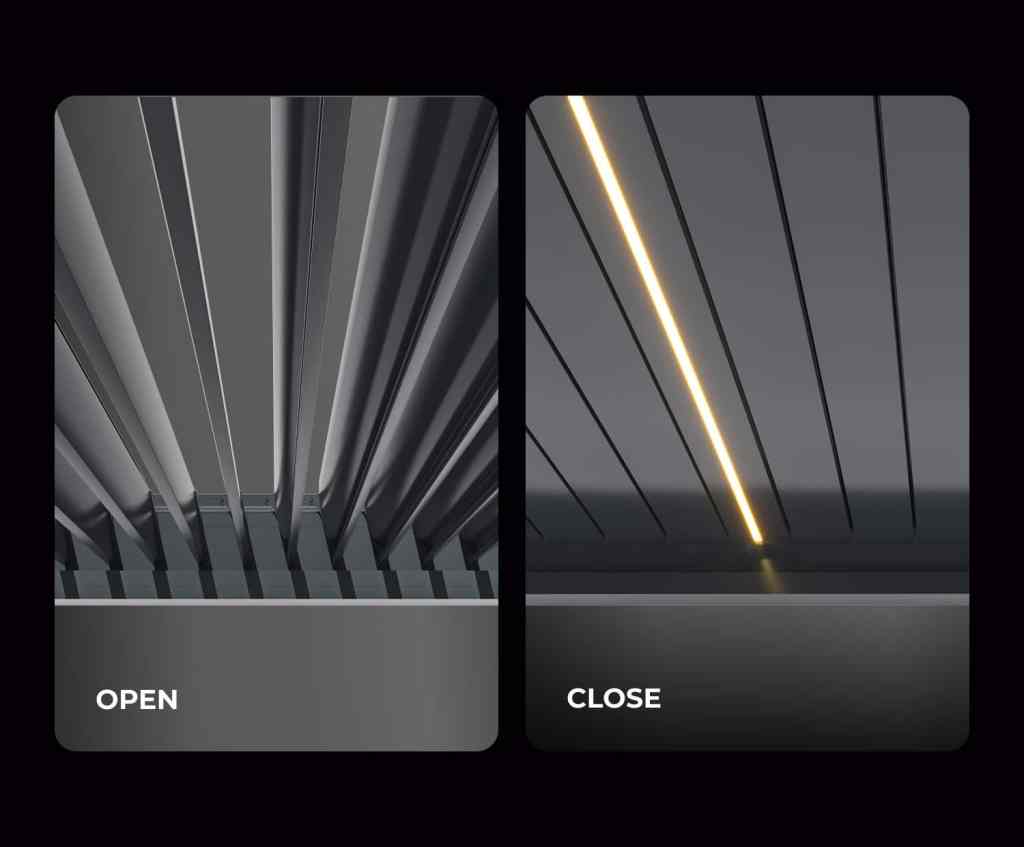
In practice, this means the roof of a bioclimatic pergola is made up of a series of aluminium louvre blades that can rotate through a full arc of up to 140 degrees. When fully open, the blades are nearly vertical, allowing air to circulate freely and sunlight to pass through. As they rotate toward horizontal, they progressively block sunlight and reduce ventilation. When fully closed, the blades overlap to form a completely sealed, watertight roof that will shed rainfall cleanly into integrated drainage channels concealed within the pergola frame.
This single mechanism — the rotating louvre blade — is what makes the bioclimatic pergola so versatile. One structure can function as an open pergola on a warm spring morning, a shaded retreat on a hot summer afternoon, and a fully weatherproof room extension during an autumn downpour.
How the Motorised Louvre System Works
The Louvre Blades
The louvre blades themselves are extruded from high-grade aluminium, precision-engineered to maintain structural integrity across their full span without sagging or twisting. Each blade is profiled so that when in the closed position it interlocks slightly with the adjacent blade, creating a weatherproof seal. Internal drainage channels run along the length of each blade, collecting rainwater and directing it toward the integrated guttering within the pergola posts — so water disappears discreetly rather than cascading off the edges.
The blades are available in a wide range of RAL powder-coat finishes, and because aluminium does not rust or degrade in the way timber or steel can, the finish remains pristine for decades with minimal maintenance.
The Motors: IP67 Rated for All Conditions
Each pergola uses an electric motor to drive the louvre blades. The motors fitted to our systems carry an IP67 ingress protection rating — and it is worth understanding exactly what that means.
The IP (Ingress Protection) rating is an international standard that defines how well a device is sealed against solid particles and liquids. The rating is expressed as two digits:
- The first digit (6) refers to protection against solid particles. A rating of 6 — the maximum — means the motor is completely dustproof. No dust, debris, or particulates can enter the motor housing under any circumstances.
- The second digit (7) refers to protection against water ingress. A rating of 7 means the motor can be submerged in up to one metre of water for up to 30 minutes without damage.
For an outdoor motor that will be exposed to British weather year-round — rain, frost, condensation, coastal salt air — IP67 is the appropriate specification. The motors are concealed within the pergola structure itself, making them invisible from below and protected from direct impact.
In operation, these motors are whisper quiet. The drive mechanism is engineered to minimise vibration and noise, so operating the roof does not disturb conversations or neighbours.
The Drive Mechanism
A single motor drives all the louvre blades across the entire roof span simultaneously via a concealed mechanical linkage. This is an important engineering point: rather than each blade having its own independent motor, a single drive system connects all blades through a rigid coupling. This ensures that every blade rotates by exactly the same angle at exactly the same time, maintaining a uniform roof profile throughout the range of motion. There is no risk of individual blades falling out of alignment or creating gaps in the weatherproof seal.
Smart Sensors: Automated Climate Control
The intelligence of a bioclimatic pergola comes from its sensor suite. These sensors monitor the environment continuously and trigger automatic adjustments to the louvre position — meaning the pergola responds to changing conditions even when you are not present to operate it manually.
Rain Sensor
The rain sensor is the most practically important automation feature. Mounted on the pergola frame, it detects moisture the instant rain begins to fall and automatically sends the louvre blades to the closed position. Your outdoor furniture, cushions, and flooring are protected without any action on your part.
This is particularly valuable when you are away from home. You do not need to check weather forecasts before leaving or rush back to close the roof manually — the system handles it automatically. When the rain stops and the sensor dries, the blades can be set to return to their previous position automatically or remain closed until you choose to open them.
Wind Sensor (Optional)
In exposed locations, a wind sensor can be incorporated into the system. This measures wind speed and, when it exceeds a pre-set threshold, automatically adjusts the louvre angle to reduce wind resistance and protect both the structure and its occupants. At very high wind speeds, the blades may be directed to fully open — allowing wind to pass through rather than exert force on a solid closed roof — or fully closed depending on the configuration specified.
Sun Sensor (Optional)
A sun sensor monitors light intensity and direction, automatically adjusting the louvre angle throughout the day to maintain a consistent level of shading. As the sun moves across the sky and its angle changes, the blades rotate to compensate, keeping the space beneath comfortable without manual intervention. This is the feature that most closely embodies the bioclimatic principle — the structure genuinely adapting to its solar environment in real time.
Control Options
A bioclimatic pergola can be operated in multiple ways, giving you complete flexibility over how you interact with the system:
- Handheld remote control — a dedicated remote allows you to adjust the louvre position, control lighting, and manage other features from anywhere within range.
- Smartphone app — via Wi-Fi or Bluetooth connectivity, you can control the pergola from your phone whether you are sitting beneath it or on the other side of the world.
- Voice control — integration with Amazon Alexa and Google Home allows hands-free operation. Simply instruct your smart speaker to open or close the roof.
- Wall-mounted switch — a hard-wired switch can be installed on an adjacent wall for convenient manual control, ideal for those who prefer a physical interface.
- Automatic sensor control — as described above, sensors can manage the system entirely autonomously based on weather conditions.
These control methods can be used in combination. You might, for example, set the rain sensor to operate automatically at all times whilst retaining manual override via the app for day-to-day adjustments.
Integrated Features: Building a Complete Outdoor Room
The bioclimatic pergola structure itself is just the beginning. Our systems can be specified with a comprehensive range of integrated features that transform the space beneath into a fully equipped outdoor room:
LED Lighting
Recessed LED lighting can be integrated directly into the louvre blades or the pergola frame, providing even, atmospheric illumination across the entire space. Strip lighting, spotlights, and colour-changing RGB options are all available, and lighting can typically be controlled through the same app or remote used for the louvre system.
Infrared Heating
Infrared heaters can be mounted within the pergola structure, extending the usable season significantly into autumn and winter. Unlike conventional convection heaters that warm the air (which then escapes freely outdoors), infrared heaters warm objects and people directly — making them far more efficient in open or semi-open outdoor settings.
Bluetooth Audio
Weatherproof Bluetooth speakers can be integrated into the pergola posts or canopy, delivering high-quality audio throughout the outdoor space without the need for exposed cables or standalone speaker units.
Side Enclosures
To complete the enclosure and extend all-weather usability, a range of side elements can be added:
- Zip screens — motorised fabric screens that roll down to block wind, rain, and insects whilst maintaining visibility and ventilation. Available in solid, perforated, or transparent materials.
- Glass sliding doors — frameless or slim-framed glass door systems that convert the pergola into a fully enclosed glazed room when closed, yet open completely to create a seamless indoor-outdoor connection.
- Fixed glass panels — where a permanent windbreak is required without the need for opening, fixed glazed infills can be specified for one or more sides.
Why Aluminium Is the Ideal Material
Every structural element of a bioclimatic pergola — frame, posts, louvre blades, gutters, and fixings — is manufactured from aluminium. This is not simply a convention; aluminium is genuinely the optimum material for this application, for several reasons:
- Corrosion resistance — aluminium forms a natural oxide layer that protects it from rust and corrosion. Unlike steel, it will not degrade in the damp British climate, coastal environments, or where it is in contact with concrete or masonry.
- Strength-to-weight ratio — aluminium is remarkably strong relative to its weight, allowing the pergola to span large distances and carry snow loads without requiring heavy, intrusive posts or beams.
- Precision engineering — aluminium extrudes to extremely tight tolerances, enabling the close-fitting interlocking profiles required for a genuinely watertight louvre system. The precision of the components is what makes the weatherproofing reliable.
- Zero maintenance — a powder-coated aluminium pergola requires no painting, treating, or sealing. An occasional wash with soapy water is all that is needed to keep it looking immaculate.
- RAL colour range — powder coating can be applied in any RAL colour, giving you complete freedom to match the pergola to your home, garden design, or personal preference. Anthracite grey, cream white, and classic black are perennially popular choices.
- Sustainability — aluminium is 100% recyclable without any loss of quality, making it one of the most environmentally responsible structural materials available. Many of our profiles contain a significant proportion of recycled aluminium content.
Is a Bioclimatic Pergola Worth the Investment?
A bioclimatic pergola represents a significant investment compared to a basic timber pergola or a fixed polycarbonate canopy — and it is worth being clear-eyed about why that investment is justified.
The core value proposition is versatility and longevity. A fixed structure offers one level of shelter in one configuration. A bioclimatic pergola offers every configuration from fully open to fully weatherproof, adapts automatically to changing conditions, and can be enhanced with lighting, heating, audio, and enclosures to create a functional outdoor room that is usable for twelve months of the year rather than three or four.
The maintenance cost is genuinely negligible. Unlike timber, which requires regular treatment and will eventually decay, or steel, which must be protected from rust, aluminium simply endures. The motors and sensors are industrial-grade components specified for outdoor continuous use. The system is designed to operate reliably for decades.
From a property perspective, a well-specified bioclimatic pergola adds measurable value to a home by extending the usable living space in a way that is immediately visible and appealing to prospective buyers. It is a considered architectural addition, not a temporary garden accessory.
For anyone who takes their outdoor living space seriously — whether for personal enjoyment, entertaining, or adding long-term value to their property — a bioclimatic motorised louvre pergola is, in our view, the definitive solution.
Explore Our Aluminium Pergola Range
Direct Trade Windows supplies and installs premium bioclimatic pergola systems throughout the UK. To see our full range of specifications, configurations, and finish options, visit our aluminium pergolas product page.
Ready to discuss your project? Our technical team can advise on sizing, specification, sensor configuration, and integrated features to create the ideal solution for your outdoor space. Request a quote today — we will respond promptly with detailed information tailored to your requirements.